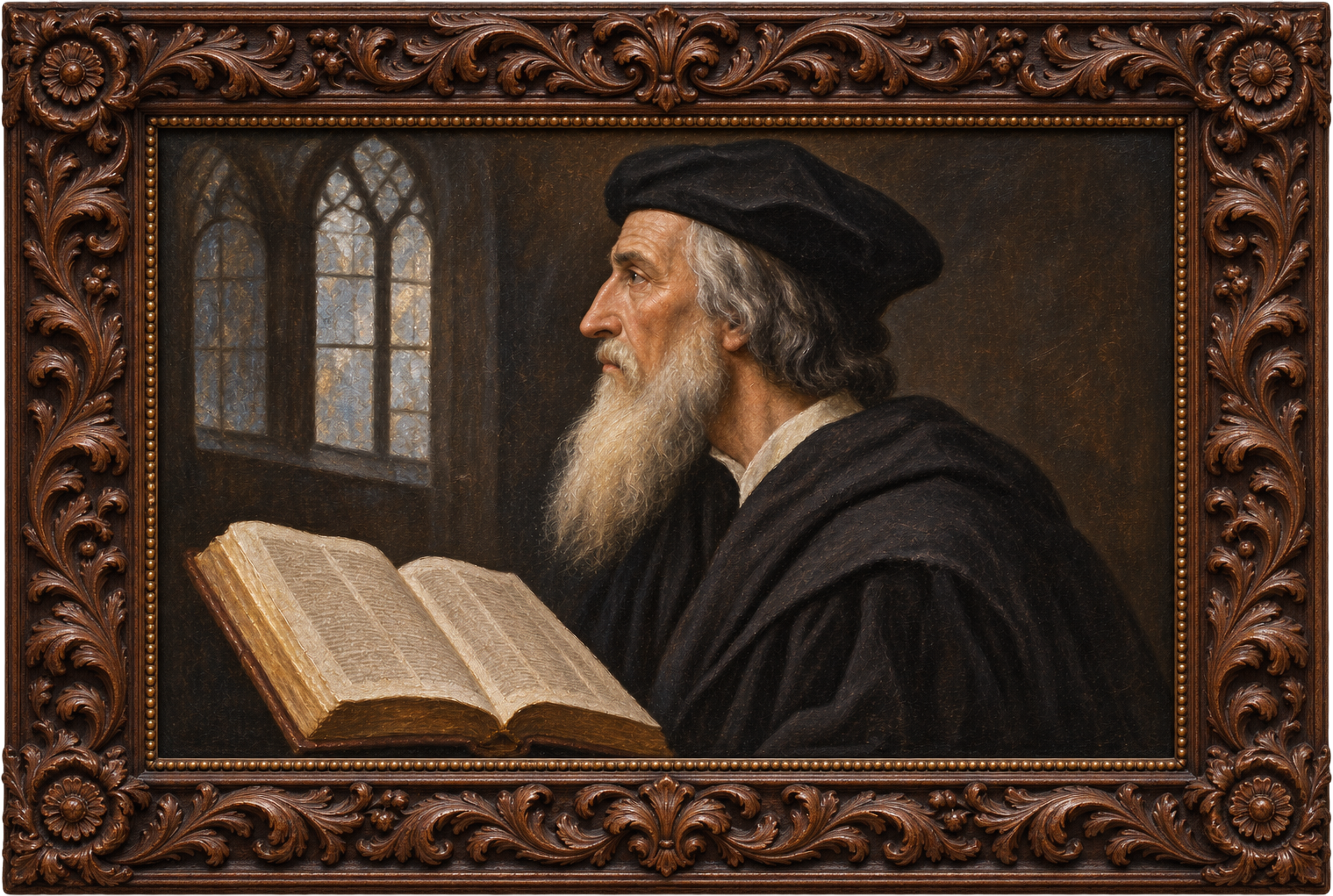
John Wycliffe
c. 1330–1384
Life
John Wycliffe was a fourteenth-century English theologian, Oxford philosopher, and the most important precursor of the Reformation in England. He criticized papal authority, the wealth of the clergy, transubstantiation, and the dependence of the church on temporal power. Wycliffe argued that Scripture is the final authority for Christian doctrine and life, and so he promoted its translation into English. His followers, the Lollards, continued to spread his ideas after his death. Although he died in communion with the church, his teachings were later condemned, and his bones were exhumed and burned in 1428. Wycliffe’s emphasis on the Bible in the vernacular and his critique of medieval ecclesiastical structures made him a significant influence on later reformers, including Jan Hus.
Selected Writings
- The Wycliffe Bible translation (though Wycliffe was not the sole translator)
- On Divine Dominion and On Civil Dominion
- On the Truth of Holy Scripture
- Various sermons and theological and philosophical treatises
- A large body of work associated with the Lollard movement

